

A crypto desk on AUSTRAC’s books may have been a waypoint on a money route from Iran to Gaza. That is the claim in a Nominis report dated 19 November.
An OTC desk trades big parcels of crypto privately, away from public exchange screens. This one is Australian, according to Nominis, and it is a branch of a larger Iran-based operator that also works in Turkey.
The report does not name the desk. AUSTRAC has not named it publicly either.
A phone call found it, not a blockchain scan
Nominis says its analysts made contact with people in the OTC world and walked away with a wallet address. When collected, that wallet had received about US$4 million.
The firm adds that the entity sits on the AUSTRAC register as a legal entity. It shows no sign of legal action or penalties across its time registered.
How it was found matters. Nominis says on-chain tracing alone would have missed this desk, and a human conversation got the team there.
That is an awkward line for any compliance shop that runs on software alone. If the way in is a chat, a screening tool starts with half the map.
Sanctioned exchanges and a timing problem
Per Nominis, the wallet had exposure to two platforms, Rapira and Coinex.
Rapira is registered in Georgia. Georgia’s finance ministry alleges it has no assets or offices there and runs out of Moscow. The UK sanctioned it in May 2026, and Nominis says Australia, Ukraine, Canada, Switzerland and the EU followed.
Coinex is the odd one. It was never sanctioned, yet Nominis’s head of intelligence says it moved billions of dollars to Iranian entities before it shut in September 2026.
Now the catch. The report gives no dates for the flows.
If money touched Rapira before May, the picture changes. Exposure to Coinex was never a sanctions issue at all.
Australian law treats crypto as an asset, so dealing with a designated entity is a breach. The question is who touched what, and when.
Gaza is the soft part of the claim
Nominis says the desk had exposure to IRGC terror financing infrastructure and to a Gaza OTC “highly likely” tied to Hamas. Highly likely is the firm’s wording. It is not a finding of fact.
The size is modest too. US4millionissmallbesidetheUS635 million Nominis says moved through Hamas-linked Gaza OTC infrastructure, per its own annual report.
So the story is the route, not the amount. A registered Australian desk is useful plumbing because Australia screens as low risk, and Nominis makes that same argument. That clean reputation is the thing being borrowed.
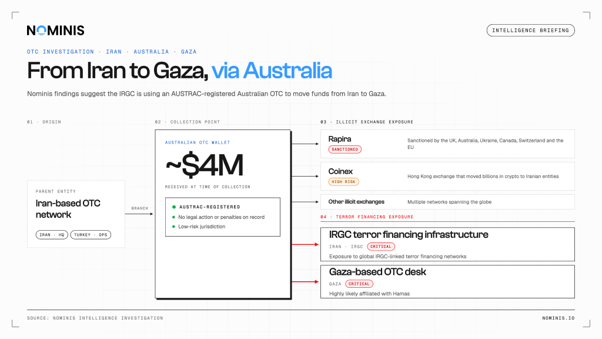
Route alleged by Nominis. The Australian desk is unnamed and none of the links have been confirmed by a regulator. [Nominis]
AUSTRAC oversight starts at registration, not approval
Australia widened its crypto rules from 31 March 2026. Digital currency exchanges became virtual asset service providers, and AUSTRAC put a searchable public register online in June.
In September the regulator said it had cancelled, suspended or refused to renew 45 remittance and virtual asset registrations over 12 months. It did not name them all or split crypto from remittance.
It also ran an OTC campaign ahead of the reforms. AUSTRAC spoke directly with 36 crypto businesses about their business models and how they manage laundering risk.
That campaign sounds closest to what Nominis describes. Nothing public ties it, or any of the 45 actions, to this desk, and a search on 20 November found no AUSTRAC statement on the report.
A register tells a bank or a customer that a business has enrolled and carries duties. It does not show anyone checked what sits behind the owners, or what an overseas parent gets up to.
Registration is where supervision begins. If the Nominis claim holds, AUSTRAC’s “high barrier to entry” line gets a real test.
The source sells screening tools
Nominis is a vendor. Its report closes with a pitch for wallet screening and transaction monitoring.
The firm is also Israeli-founded, which readers on a Gaza story should know. That alone says nothing about the data.
No regulator, court or second analytics firm has publicly confirmed the findings, as far as searches show. The claims need treating as claims.
For Australian crypto users, the AUSTRAC register is a fair first check, but only a first one. For compliance teams, the lesson is to look past the first hop and ask for timestamps. For everyone else, the useful move is to wait for AUSTRAC to speak.
Also Read: Anthropic Nasdaq listing: what US$83 a share is buying
FAQs
Q: What is an OTC crypto desk?
A: A business that trades large amounts of crypto privately instead of on a public exchange.
Q: Has the Australian OTC been named?
A: No. Nominis has not named it.
Q: Has AUSTRAC confirmed the findings?
A: Not publicly, as of 20 November 2026.
Q: Is Rapira sanctioned?
A: The UK listed it in May 2026. Nominis says other countries followed, including Australia.
Q: How can anyone check an Australian crypto business?
A: Search AUSTRAC’s public register of virtual asset service providers.
Disclaimer: This article is general information only and is not financial, legal or investment advice. Crypto assets are volatile and high risk. Allegations in the Nominis report are unproven and have not been confirmed by any regulator or court.

Diana Alexandra is an experienced editor and content strategist with over a decade of expertise across publishing, digital media, and quality assurance. Holding an MA in English and specialised credentials in journalism and editorial practice, she transforms complex ideas and raw drafts into sharp, SEO-driven, and reader-focused copy that meets rigorous publication standards.