
The Anthropic Nasdaq listing opens in New York on Thursday morning, which is 1.30am Friday in Sydney. Nasdaq has not set a time for the first trade.
Anthropic, the company behind Claude, set its price on Wednesday night in New York. The demand story is easy to read. The business story takes more work.
The Anthropic IPO price came in above range, then the deal grew
Bankers first talked up US$70 to US$78 a share. Buyers paid US$83.
The share count rose too, from 825 million to 980 million, lifting the haul to US$81.3bn and past the US$75bn SpaceX raised in June. Raising the price and the share count together says demand beat the banks’ guesses.
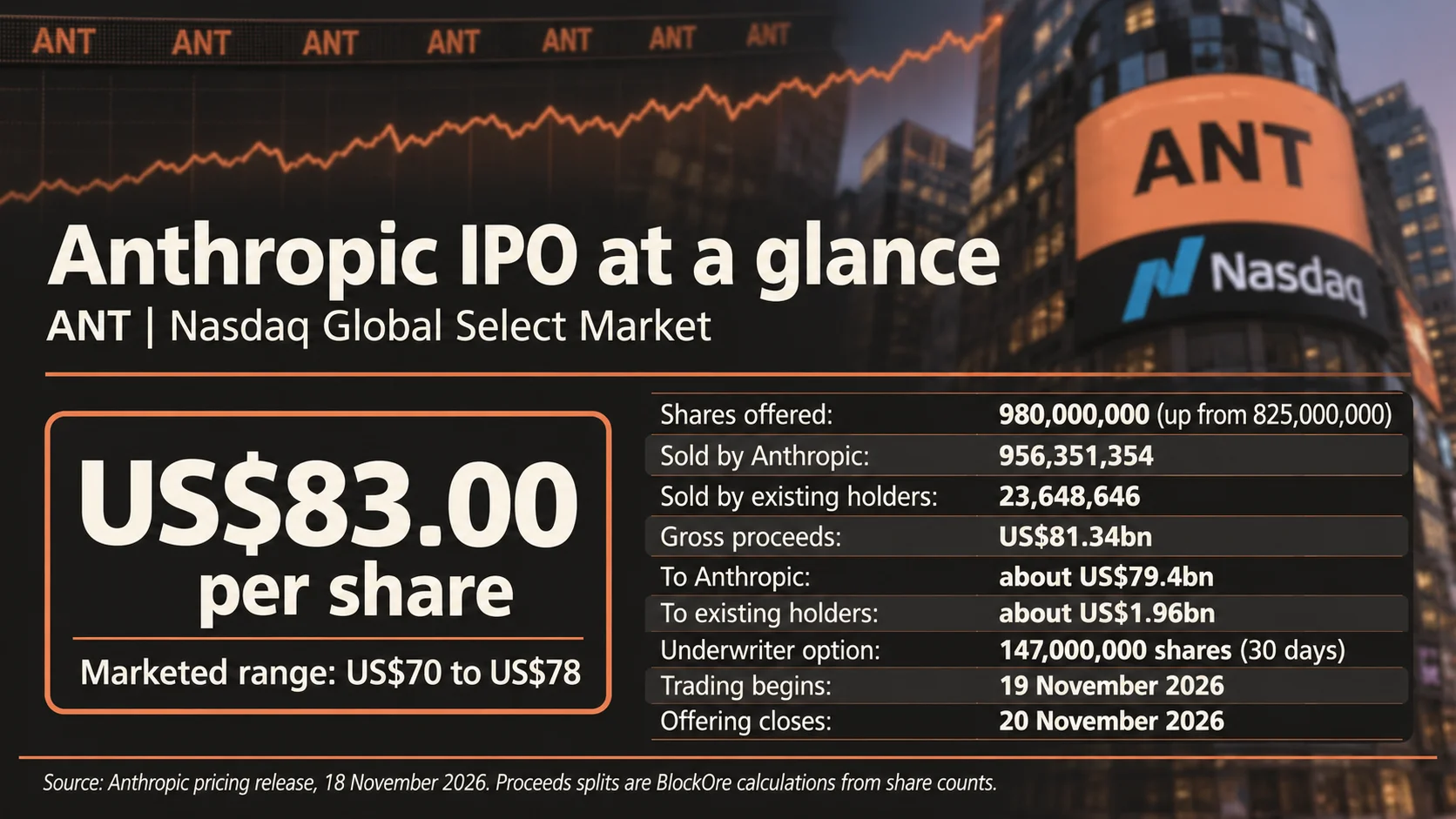
Anthropic’s IPO terms as priced on 18 November 2026. Dollar splits are BlockOre calculations from the share counts.
Anthropic itself sells 956,351,354 shares. Existing holders sell the other 23,648,646, and Anthropic collects nothing from those. The pricing release is the source for those splits.
Run the maths and Anthropic’s own take is about US$79.4bn, with holders collecting roughly US$1.96bn. Underwriters also hold a 30-day option on another 147 million shares, worth about US$12.2bn at this price.
Reports put retail orders at about six times the shares available. Books that many times covered tend to be padded, because big orders go in hoping for a bigger slice. Six times is a mood, not a measurement.
The Anthropic valuation needs revenue to outrun costs
The US$1.5tn figure is fully diluted, so it counts every share and option, not only the stock about to trade.
Revenue for the first nine months of 2026 hit US$33.2bn. The third quarter alone brought in nearly US$17bn, up 46% on the second. Annualise that quarter and sales run near US$68bn. The market is paying about 22 times it.
Now the awkward part. Compute costs, the chips and data centres that run Claude, climbed 77% over the same stretch.
Revenue up 46%. Machines up 77%. That gap is the whole debate.
The second quarter delivered a US$974m operating profit. The third slid to a US$567m loss, which Anthropic put down mainly to US$5.0bn of compute bought on short-term deals. The filing admits that kind of capacity costs far more than multiyear contracts.
Management’s preferred yardstick looks kinder. Adjusted operating margin was 19% in the second quarter and 15% in the third. Adjusted numbers leave out items the company chooses, so the plain loss is the safer guide.
One worry is off the table. No single customer made up more than 10% of revenue in the nine months to 30 September.
A US$895bn compute bill sits behind every Claude answer
Anthropic’s amended filing lists about US$895bn of commitments, nearly all for computing and data centres, with about US$70bn due within a year. The amended S-1 carries the detail.
Cash and short-term investments stood near US$132bn at the end of September. Add the US$79bn raised now and the pile reaches about US$211bn, roughly a quarter of the commitments.
So the IPO works more like a deposit than a victory lap. The listing buys time. It does not close the gap.
Here is a detail only a filing reader would catch. Once all capacity arrives, Anthropic pays SpaceX about US$3.1bn a month for Nvidia-powered computing. SpaceX listed on Nasdaq in June. Its customer follows five months later.
Usage-based billing adds a twist. Consumption fees made up US$13.1bn, or 80%, of first-half revenue. When customers use less Claude, revenue drops straight away. The data centre leases do not.
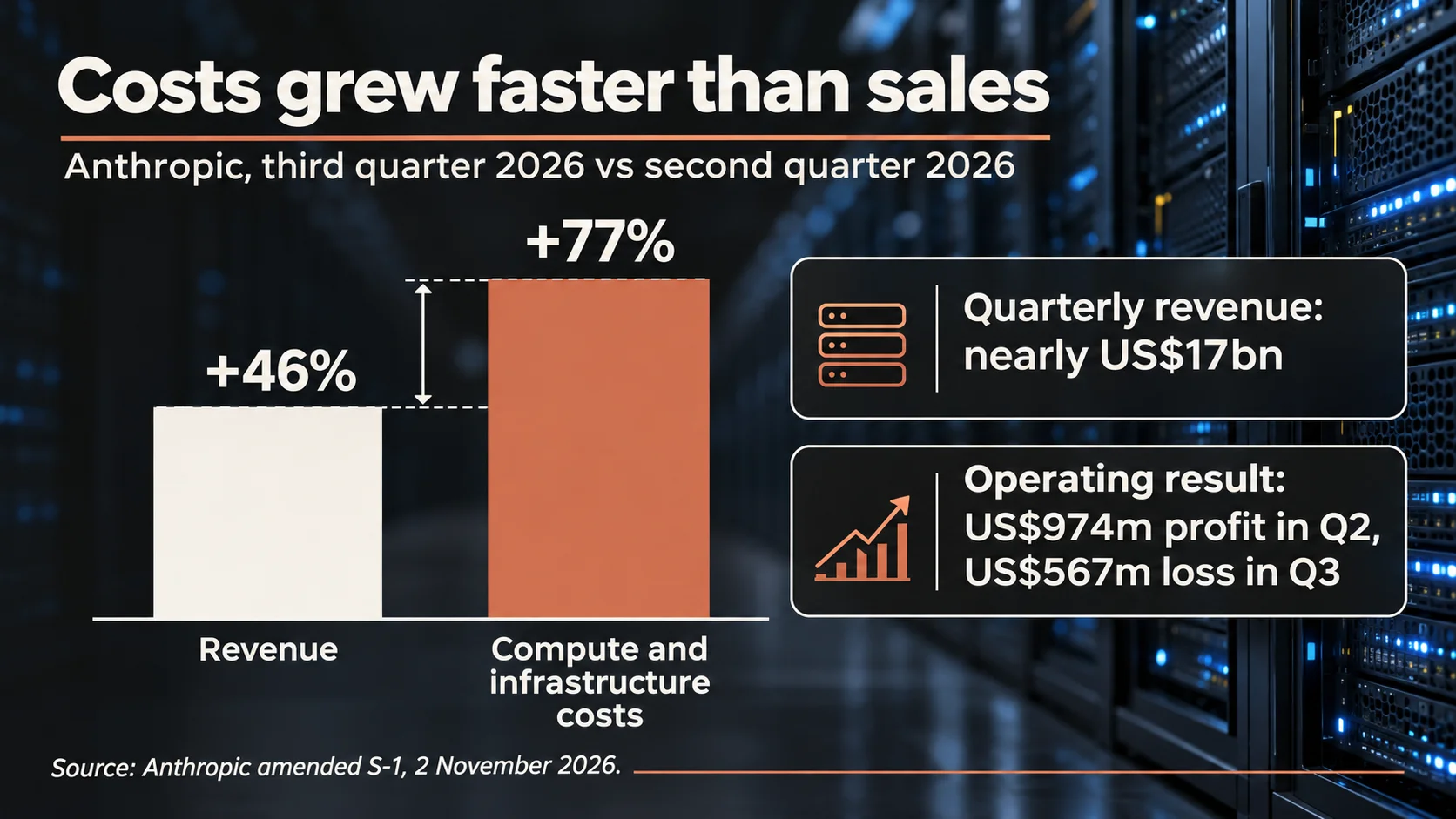
Compute costs grew faster than revenue in Anthropic’s third quarter.
Insiders can sell on day one, and Australians get a thin slice
Employees holding roughly 15% of the equity may sell some shares on the first day. Early supply like that can cap a pop.
SpaceX shows how fast the mood can turn. It priced at US$135, ran to about US$211 within a week, then sat below its issue price a month later, by Canooq’s tally. BlockOre has followed other fresh Nasdaq names too, including Evernorth’s Nasdaq debut.
For Australians, access is narrow. IG Australia let eligible customers buy one share at the final price. Anthropic also lodged an Australian prospectus.
Everyone else buys after the open, in US dollars, at whatever the first-day price turns out to be. That is a different deal from US$83.
The ANT debut will say a lot about appetite for AI shares. It will say very little about whether the business works.
That test arrives quarter by quarter. Revenue has to keep growing faster than compute, for years. At US$1.5tn there is little room for being almost right.
Also Read: XRP Price Faces a Critical Turning Point as Market Selling Pressure Builds
FAQs
Q: What is the Anthropic ticker?
A: ANT, on the Nasdaq Global Select Market.
Q: What was the Anthropic IPO price?
A: US$83 a share.
Q: How much did Anthropic raise?
A: About US81.3bngross,withroughlyUS79.4bn going to the company.
Q: When does ANT start trading?
A: 19 November in New York, early on 20 November in Sydney.
Q: Can Australians buy ANT?
A: Yes, through brokers offering US shares.
Q: Is Anthropic profitable?
A: Not on a GAAP basis. It lost US$567m at the operating line in the third quarter.
Disclaimer:
This article is general information only and is not financial advice. Consider your own circumstances and speak to a licensed adviser before investing.

Diana Alexandra is an experienced editor and content strategist with over a decade of expertise across publishing, digital media, and quality assurance. Holding an MA in English and specialised credentials in journalism and editorial practice, she transforms complex ideas and raw drafts into sharp, SEO-driven, and reader-focused copy that meets rigorous publication standards.