


Network operators removed computing power from the Bitcoin network. Miners disconnected machines across data centres. The network computing output fell to under 700 exahashes per second by November 2026.
The system algorithm reacted to this hardware removal. The protocol lowered the mathematics target to maintain block generation schedules. The adjustment ensured ten-minute block intervals.
Data centre operators unplugged processing units to conserve electricity. The software adjustments maintained the settlement schedule. Facility owners switched off machines to save money.
Operators redirected megawatts of power toward machine learning tasks. The network hash rate dropped over 11 per cent during November 2026. Energy suppliers charged 46,426 United States dollars to power the extraction of one coin in March 2026.
When machines leave the network, the puzzle becomes easier to solve. The changes triggered revenue shifts across the sector.
- Operators removed thousands of processing machines.
- The network protocol adjusted the mining mathematics.
- Companies prioritised colocation services over coin generation.
- Facility managers installed graphics processing units.
Why This Shift Matters to Every Tech & Market Reader
Investors monitor these hash rate fluctuations. Hash rate levels determine network security parameters. A network with machine drops requires less energy to reorganise.
Network users rely on this security to transfer value across borders. Energy grid managers also watch these infrastructure shifts. Miners consume megawatts of electricity every hour.
When operators power down, energy returns to the grid. Grid controllers use this returned power during peak demand hours. Shareholders of cryptocurrency companies also track these equipment changes.
Profit margins dictate company survival in this sector. When block rewards fail to cover electricity bills, operators sell treasury assets. These sales add supply to the market.
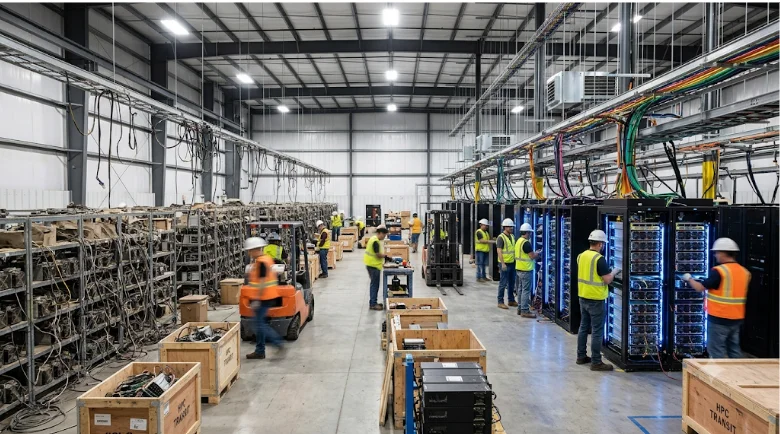
Technicians replace decommissioned cryptocurrency hardware with high-performance AI server racks.
Market supply increases put pressure on asset prices. Stock buyers watch these companies transition business models. Revenue diversification provides stability for shareholder returns.
Consumers of artificial intelligence also benefit from these shifts. The machine learning industry needs power to train models. Cryptocurrency facilities provide infrastructure for this task.
Machine learning algorithms process terabytes of information. This processing requires megawatts of electricity. Data centre owners rent rack space to technology companies.
The rental agreements generate revenue streams. The computing demands from artificial intelligence will exceed 1,000 terawatt-hours by late 2026. The sector transformation affects technology investors across the globe.
Key Players: The Companies and Sectors Pivoting to AI
Cryptocurrency mining companies drive this transition across the board. Core Scientific announced plans to exit block mining by the fourth quarter of 2026. The operator will transition entirely to artificial intelligence colocation.
Other market participants follow paths to maintain profits. Riot Platforms secured a lease with an artificial intelligence laboratory. The deal guarantees 191 megawatts of information technology capacity.
HIVE Digital began winding down Sweden operations to build computing infrastructure in Canada. MARA Holdings sold 15,133 coins to fund balance sheet strength. The company reduced its workforce by 15 per cent to reallocate capital.
Cipher Digital develops a 300-megawatt site at Barber Lake. The developer secured an agreement with Fluidstack. Hut 8 expands into colocation infrastructure to diversify revenue.
Hardware manufacturers also face business model shifts. Bitmain must adapt to operator demands. Energy suppliers negotiate power purchase agreements with these companies.
Shareholders demand revenue diversification from company boards. The sector involves participants across finance and technology.
- Core Scientific shifts focus to colocation services.
- Riot Platforms signs deals with machine learning laboratories.
- MARA Holdings sells reserves to fund operations.
- HIVE Digital relocates resources to Canada.
- Cipher Digital builds infrastructure for technology companies.
Global Footprint: Where the Hash Rate Migration Is Happening
This infrastructure transition spans continents and jurisdictions. North America hosts the bulk of this activity. Texas power grids supply electricity to many mining facilities.
Georgia and North Carolina also host data centres. Operators in these states face grid power price increases. Facilities in Canada attract investment for artificial intelligence expansion.
Europe experiences hardware shutdowns. Miners in Sweden decommission machines to pivot business models. Power costs in Scandinavia restrict profitability for block validation.
Australian operators also adjust power consumption patterns. Data centres in Queensland modify operations to avoid peak energy tariffs. Western Australia facility owners explore colocation options.
Asia also sees shifts in hardware deployment. Companies in Central Asia must navigate energy regulations. The transition impacts facilities everywhere.
Managers in the United States project grid electricity prices will hit 51 United States dollars per megawatt-hour. This price point forces operators to evaluate location viability. Companies seek regions with budget power options.
The network consumes gigawatts of power. Data centres in Texas connect directly to the ERCOT grid. The grid operator requests power curtailments during storms.
Operators in Iceland and Norway utilise geothermal energy. The energy sources determine the profitability of the operations. The geography of mining continues to shift toward regions with excess power.
Also Read: Bitcoin Slides to US$76,000 as an AI Stock Rout Drags Crypto Lower
Timeline of a Transformation: How the 2024–2026 Shift Unfolded
The network difficulty reached records in late 2025. Market pressures intensified throughout 2026. Production costs for one block reward hit 88,341 United States dollars after the April 2024 halving event.
By March 2026, companies chased 70 billion United States dollars in artificial intelligence contracts. Operators accelerated the transition during the third quarter of 2026. Core Scientific reported a 60 per cent revenue jump from colocation services during this period.
During the second quarter of 2026, the hash rate fell by 5.8 per cent to 1,004 exahashes per second. The company billed clients for 485 megawatts of power capacity by September 2026. The network executed a difficulty reduction in November 2026.
The hash rate fell by over 11 per cent by 9 November 2026. Operators turned off machines during summer heatwaves. The energy demand reached limits during these months.
Companies capitalised on the demand by selling power back to the grid. The timeline shows a shift in business strategy.
- April 2024: The block reward protocol drops output to 3.125 coins.
- January 2026: Production costs average 74,300 United States dollars.
- March 2026: Firms pursue colocation contracts.
- September 2026: Colocation revenue eclipses block rewards for operators.
- November 2026: Hash rates plunge over 11 per cent.
The Power Play: How Algorithm Adjustments and AI Retrofits Will Play Out
Grid electricity prices forced the machine shutdowns. Companies paid up to 74,300 United States dollars to produce one coin in January 2026. The mathematics mandate a network correction when machines disconnect.
The protocol algorithm assesses block times every 2,016 blocks. The software lowers the validation threshold to match the remaining machine count. The sector will continue transitioning hardware to support machine learning.
One megawatt of capacity generates 1.9 million United States dollars over five years through cryptocurrency mining. That same megawatt yields 7.9 million United States dollars via artificial intelligence hosting. Companies will retrofit warehouses to support machine learning networks.
Operators will retire at least 35 exahashes of computing power from the network. Data centres will install graphics processing units to replace processing machines. Revenue from colocation will surpass revenue from block generation.
The transition requires capital expenditure from facility owners. Operators must install cooling systems to support graphics processing units. These upgrades allow data centres to sign lease agreements.
The Bitcoin network will operate with machine drops. The industry will consolidate as competitors face bankruptcy. Power providers will prefer artificial intelligence clients over cryptocurrency miners.
The ledger will maintain security through the difficulty adjustment algorithm. The software ensures the system adapts to hardware loss. The market forces dictate resource allocation across the technology sector.
FAQs
Q: What exactly is a hash rate?
It is the total computing power dedicated to validating transactions and securing the Bitcoin network.
Q: Why are miners unplugging their hardware?
High electricity bills and reduced block rewards have squeezed profit margins, forcing operators to shut down older, less efficient machines to cut costs.
Q: What happens to the Bitcoin network when computing power drops?
The system’s algorithm automatically lowers the mining difficulty. This mathematical adjustment ensures transactions are still processed every 10 minutes, even with fewer machines running.
Q: Where is this unused power going?
Mining companies are rewiring their facilities to lease rack space and power to artificial intelligence and machine learning firms, which currently offer much higher returns than crypto mining.
Disclaimer:
The information provided in this article is for informational purposes only and does not constitute financial, investment, or trading advice.

Diana Alexandra is an experienced editor and content strategist with over a decade of expertise across publishing, digital media, and quality assurance. Holding an MA in English and specialised credentials in journalism and editorial practice, she transforms complex ideas and raw drafts into sharp, SEO-driven, and reader-focused copy that meets rigorous publication standards.