


Blockchain trackers recorded three transfers moving $195.6 million in crypto out of exchange custody within a window of three hours on Thursday. Coinbase Institutional initiated the sequence by sending $100 million in USDC to a wallet without attribution. Galaxy Digital followed with two transfers that shifted $69.2 million in Bitcoin and $26.4 million in HYPE to wallets lacking owner labels.
During those three hours, exchanges recorded zero inflows to offset the withdrawals. Analytics service Whale Alert flagged all three transactions on ledgers as traders monitored liquidity across trading venues. Financial outlets TokenPost and Pluang subsequently published reports detailing the outflows for market participants.
The $195.6M Exchange Exodus: What Went Down
Coinbase Institutional and Galaxy Digital executed three withdrawals totalling $195.6 million before the close of trading in New York on 12 November 2026. Each transaction moved assets away from exchange infrastructure into destinations with zero transaction history on the blockchain. Together, these movements drained nearly $200 million in liquidity from exchange order books without generating a deposit in return.
Ledgers on blockchains document the breakdown of the outflows across three assets:
- Coinbase Institutional transferred 100,000,000 USDC, carrying a value of $100 million, to a wallet without attribution, accounting for 51.12 per cent of the outflow volume.
- Galaxy Digital sent 966 Bitcoin, carrying a value of $69,164,344 or roughly $69.2 million, to a wallet with zero history at 4:27 p.m. ET, representing 35.38 per cent of the volume.
- Galaxy Digital dispatched 367,291 HYPE tokens, carrying a value of $26,386,587 or roughly $26.4 million, to a destination wallet with zero history at 4:28 p.m. ET, making up 13.50 per cent of the volume.
Reporter Enna Lee documented these figures for TokenPost at 7:31 p.m. EST on 12 November 2026. Her report noted that wallet destinations lacked attribution, preventing observers from confirming the intentions of the recipients. Pluang echoed those findings hours later on 13 November 2026 as traders analysed the scale of the outflows.
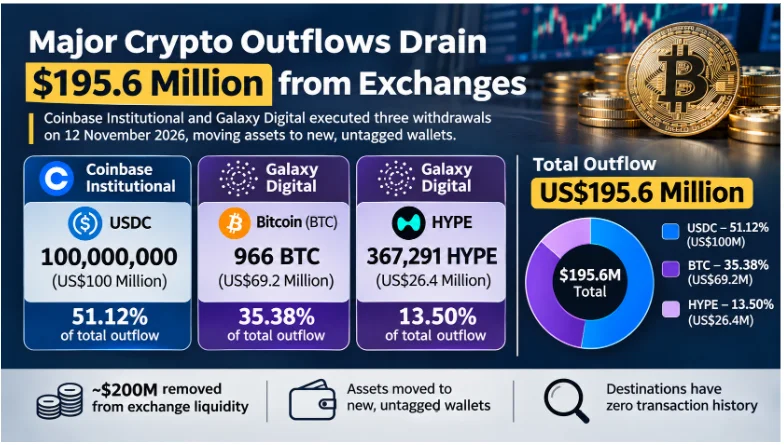
$195.6M in crypto withdrawn from major exchanges
Liquidity Drain: Why Traders Should Take Notice
Readers tracking crypto markets scrutinise exchange outflows because withdrawals alter supply dynamics on trading platforms. When institutions remove Bitcoin, USDC, and HYPE from exchanges, traders lose access to that liquidity on order books. Analysts treat zero inflows alongside $195.6 million in withdrawals as a signal that institutions prioritise custody outside exchanges.
Market participants evaluate three consequences when outflows reach this magnitude:
- Liquidity on exchanges contracts when institutions pull $100 million in USDC, reducing capital for margin lending and settlement.
- Supply pressure on Bitcoin shifts when Galaxy Digital removes 966 coins from circulation on exchanges, reducing the supply of coins for buyers on spot markets.
- Price sensitivity in tokens trading on spot order books rises when holders withdraw 367,291 HYPE within one minute.
Market conditions across exchanges on 12 November 2026 amplified attention on these withdrawals. Bitcoin dropped 3.42 per cent to $71,255 as shares in the United States declined and investors weighed policy tightening from the Federal Reserve. Consequently, readers watching portfolio risk looked closely at how institutions positioned capital during a downturn.
Key Players & Powerhouses Driving the Outflows
Coinbase Institutional operates as the arm of Coinbase that serves hedge funds, corporations, and asset managers. The organisation handles custody, execution, and liquidity services for clients managing capital at scale. By transferring $100 million in USDC, Coinbase Institutional accounted for over half of the outflows during the window.
Galaxy Digital functions as a firm specialising in asset management, trading, and infrastructure for blockchain markets. The company executed two of the three withdrawals, moving $95.6 million across Bitcoin and HYPE within sixty seconds. Together, Coinbase Institutional and Galaxy Digital represent pillars of the sector connecting finance with blockchain networks.
Behind the scenes, analytics teams, journalists, and compliance officers monitor these movements in real time. Whale Alert broadcasts alerts from trackers to traders worldwide, while reporters such as Enna Lee verify figures for publications. Meanwhile, recipient wallet operators remain without identification on blockchains, leaving analysts to infer intent from transaction patterns.
Where it happened
The transfers occurred across global blockchain networks rather than inside a physical building or clearing house. USDC and HYPE transactions settled on networks supporting smart contracts, while the 966 Bitcoin moved across the Bitcoin ledger. Because blockchains operate across nodes worldwide, computers in dozens of jurisdictions validated and recorded every transfer.
From a market perspective, the activity centred on platforms serving institutions in the United States. Coinbase Institutional and Galaxy Digital maintain headquarters in the United States, where desks coordinate settlement during trading hours in New York. Observers in Asia, Europe, and Australia tracked the outflows simultaneously through feeds from TokenPost, Pluang, and Whale Alert.
Clockwork Timing: A 3-Hour Window of Mass Moves
All three transfers took place within a window of three hours ending on Thursday, 12 November 2026. Galaxy Digital initiated its Bitcoin withdrawal of $69.2 million at 4:27 p.m. ET, just as trading desks wrapped up afternoon sessions in New York. Exactly one minute later, at 4:28 p.m. ET, the firm sent $26.4 million in HYPE to a destination wallet.
Also Read: MEV Capital & The Institutional Yield Shift: Harnessing Decentralised Finance on Ethereum
Coinbase Institutional completed its $100 million USDC transfer within that window of three hours. TokenPost published its breakdown of the transactions at 7:31 p.m. EST on 12 November 2026. Pluang followed with coverage on 13 November 2026 as traders in Asia and Australia reviewed data from New York.
Behind the Scenes: How It Unfolded & What Lies Ahead
Institutions execute transfers of this scale through custody vaults and settlement engines connected directly to blockchain nodes. Operators sign transactions with keys, broadcast instructions to validators, and confirm settlement within minutes without intermediaries. Because wallets lacked owner tags, observers on blockchains saw only addresses receiving $195.6 million in assets.
Analysts outline three pathways for how these outflows will play out across markets in coming weeks:
- Institutions often move $100 million in USDC and $95.6 million in tokens into custody vaults to safeguard reserves outside exchanges.
- Trading desks frequently settle transactions over the counter by transferring Bitcoin, USDC, and HYPE directly between counterparties.
- Funds sometimes deploy USDC into protocols on blockchains or rebalance holdings across portfolios without triggering price swings on exchanges.
In the weeks ahead, traders will monitor whether recipient wallets hold these balances or return funds to exchanges. If wallets retain the 966 Bitcoin and 367,291 HYPE, exchanges will operate with a contraction in liquidity reserves. Conversely, if holders route USDC back onto trading venues, markets will absorb inflows that could fuel buying activity.
Disclaimer:
The information provided in this article is for educational and informational purposes only and does not constitute financial, investment, or trading advice. Readers should consult with a qualified financial advisor before making any investment decisions.

Diana Alexandra is an experienced editor and content strategist with over a decade of expertise across publishing, digital media, and quality assurance. Holding an MA in English and specialised credentials in journalism and editorial practice, she transforms complex ideas and raw drafts into sharp, SEO-driven, and reader-focused copy that meets rigorous publication standards.