


The explosive rise of generative artificial intelligence has triggered an unprecedented land grab in global technology, but the ultimate prize is not software, algorithms, or even silicon. It is raw electricity. As tech giants scramble to secure enough power to train next-generation large language models (LLMs), an unexpected saviour has emerged: the Bitcoin mining industry.
Over the past decade, cryptocurrency miners quietly built, permitted, and energised massive multi-megawatt industrial sites across the globe. Today, those grid-connected locations are transitioning from speculative digital asset factories into the bedrock of artificial intelligence infrastructure.
The Time-to-Power Bottleneck
The primary catalyst driving this structural shift is time-to-power, the sheer duration required to build, approve, and plug a massive data centre into the electrical grid. Under normal circumstances, constructing a high-performance computing (HPC) facility takes years. However, the bottleneck is rarely the physical building; it is the utility company.
Across major regional transmission organisations in the United States, grid interconnection queues routinely stretch between 4 to 7 years, with some backlogs pushing projected completions into the 2030s. Compounding this delay, severe global supply chain shortages have extended the lead times for critical high-voltage electrical transformers to 3 or 4 years.
Bitcoin miners operate as a highly effective shortcut. Because their operations require massive amounts of power from day one, public mining firms already possess fully legal, compliant grid interconnection permits, independent high-voltage substations, and active multi-hundred-megawatt capacity. For AI hyperscalers like Microsoft, Amazon, and Google, buying or leasing a mining site is the only legal way to bypass a half-decade grid queue.
The Financial Arbitrage: Megawatt Economics
Beyond bypassing red tape, the pivot to AI is driven by inescapable corporate economics. The profitability of Bitcoin mining is structurally volatile, highly dependent on the global hash price, and severely compressed every four years by the network’s programmatic “halving” events.
According to industrial data from institutional research firms like CoinShares, the revenue generation potential of the exact same unit of electricity changes drastically depending on the workload.
- Bitcoin Mining Economics: Generates a highly volatile, estimated $0.5 million in annualised cash flow per megawatt.
- AI & HPC Hosting Economics: Generates a highly stable, estimated $1.5 million to over $22 million per megawatt depending on whether the company provides raw infrastructure or managed cloud GPU layers.
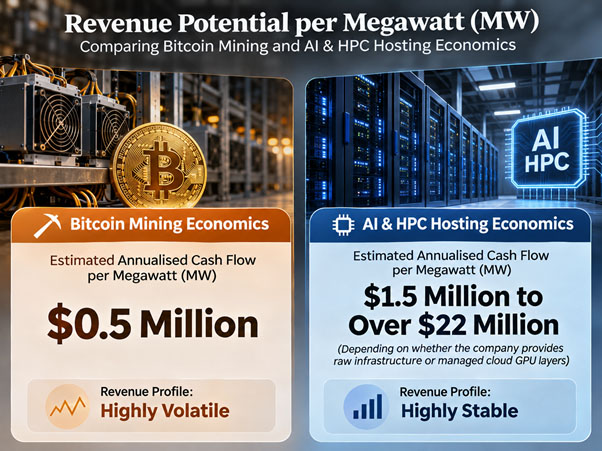
Figure: Bitcoin Mining ($0.5M/MW, highly volatile) vs. AI & HPC Hosting ($1.5M–$22M+/MW, highly stable) annualized cash flow dynamics.
This stark divergence creates a compelling capital reallocation play. By renting out their energised footprints to credit-grade technology firms, miners can lock in long-term, fixed-rate cash flows that mimic high-grade commercial real estate leases rather than highly volatile crypto markets.
Wall Street has responded favourably; institutional analysts increasingly value repurposed mining companies using data centre enterprise multiples (20x–25x EV/EBITDA) rather than standard crypto mining baselines (6x–12x).
Also Read: Robinhood Adds US$25 Million in Bitcoin as Crypto Strategy Expands
Case Study: The Megawatt Megadeals of 2026
The convergence of these two industries is no longer theoretical. A wave of monumental structural agreements has completely reshaped the landscape of public mining infrastructure:
| Public Infrastructure Provider | Tech Partner / Cloud Tenant | Stated Base Contract Value | Power Allocation & Infrastructure |
| Riot Platforms | Frontier AI Lab | $28.0 Billion | 910 MW powered land lease at Corsicana, TX campus |
| Core Scientific | CoreWeave | $10.2 Billion | 350 MW of energised capacity across multi-site hosting |
| IREN (Iris Energy) | Microsoft | $9.7 Billion | 200 MW IT load cloud cluster at Childress, TX site |
| TeraWulf | Fluidstack (Google-backed) | $9.5 Billion | 200+ MW critical IT load at Lake Mariner facility |
| Cipher Mining | Amazon Web Services (AWS) | $5.5 Billion | 15-year long-term infrastructure provisioning agreement |
The structural anatomy of Riot Platforms’ landmark Corsicana agreement provides a clear blueprint for this asset class. Under the 15-year triple-net lease, Riot is responsible for delivering the physical land, high-voltage energised pads, and core power distribution infrastructure. The AI tenant absorbs 100% of the cost to procure, install, and operate their custom modular compute systems. This shields the developer from expensive chip depreciation cycles while locking in an estimated $1.8 billion in predictable annual revenue.
Also Read: How Crypto Exchanges Work: A Beginner’s Guide to Buying and Trading Crypto
The Retrofitting Hurdle: It’s Not Simply “Plug-and-Play”
While the underlying power interconnections are incredibly valuable, converting the actual facilities requires deep technical modifications. Cryptocurrency mining is inherently rugged and flexible; application-specific integrated circuits (ASICs) are typically hosted in uninsulated, open-air warehouses using basic, cost-effective evaporative cooling fans. If the electrical grid experiences peak load stress, Bitcoin miners can shut down their entire operational load within seconds without causing software errors.
AI training clusters are vastly different. Deployments running high-performance hardware like NVIDIA’s GB300 configurations require highly secure, tightly regulated Tier 3 data centre footprints. They mandate 99.99% operational uptime with multi-layered N+1 network redundancies. Abruptly cutting power during an ongoing LLM training run can corrupt months of continuous computation, causing massive data loss.
FAQs
Why do AI companies want Bitcoin mining sites instead of building new data centres?
Ans: Building a new data center from scratch leaves companies stuck in utility waitlists for up to seven years just to get connected to the electrical grid. Bitcoin mining sites already possess active, massive power connections and substations, allowing AI companies to bypass years of red tape and launch their hardware immediately.
Can AI chips run inside existing Bitcoin mining warehouses?
Ans: Not without major upgrades. Bitcoin mining uses rugged, open-air warehouses with basic fan cooling. AI chips require highly secure, climate-controlled environments with advanced liquid cooling systems and backup power generators to prevent data corruption during training sequences, requiring significant retrofitting.
Is AI hosting more profitable for miners than mining cryptocurrency?
Ans: Yes, significantly. Bitcoin mining revenue fluctuates wildly based on crypto prices and network halving events. Leasing infrastructure to AI companies provides highly stable, predictable revenues that can generate up to four to five times more money per megawatt under long-term, guaranteed contracts.

Diana Alexandra is an experienced editor and content strategist with over a decade of expertise across publishing, digital media, and quality assurance. Holding an MA in English and specialised credentials in journalism and editorial practice, she transforms complex ideas and raw drafts into sharp, SEO-driven, and reader-focused copy that meets rigorous publication standards.