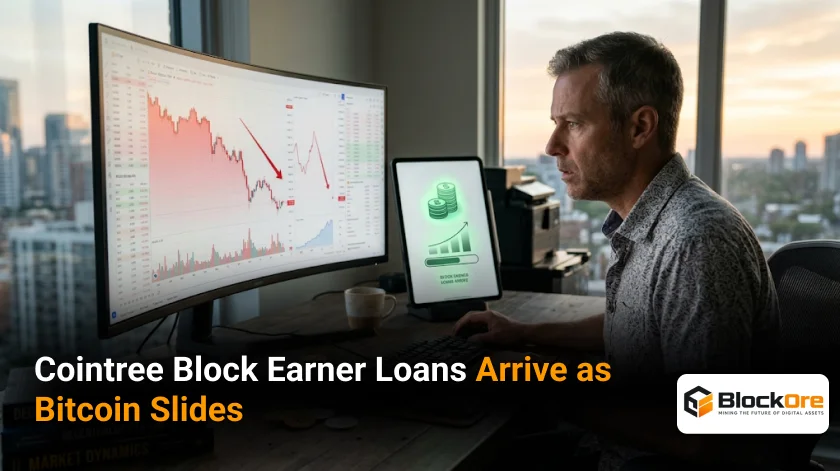
Cointree has added a door to its platform that leads straight to Block Earner. Eligible customers start the loan in their Cointree account, then finish the application and credit check on Block Earner’s side.
Cointree isn’t the lender. Its own release says it makes no credit decisions. Block Earner handles approval, repayments, the security and the loan-to-value ratio.
The timing stands out. Independent Reserve had Bitcoin at US$74,958 on 10 November, a fifth red week.
A referral link, not a lending business
The fine print tells the real story. Cointree’s disclaimer says it introduces customers to Block Earner under a referral arrangement. It also names Digital Capital Services Pty Ltd as a credit representative of Block Earner, acting only as an intermediary.
For an exchange, that’s a tidy setup. There’s a loan product on the shelf and no loan book to fund.
The pitch is easy to guess. A holder who needs cash normally sells, and a sale can end the relationship. A loan gives that customer a reason to stay.
Cointree hasn’t spelled out the mechanics. On Independent Reserve’s version of the same deal, security is sent to a wallet address that Block Earner supplies.
Cointree also isn’t first. Independent Reserve already routes customers to Block Earner, accepting Bitcoin, Ether and XRP as security with an A$5 million ceiling.
Two exchanges in, and the lender’s name is the same on both. Block Earner is becoming the engine behind other people’s storefronts. That’s the part worth watching.
What a 50 per cent loan looks like when Bitcoin drops
Block Earner’s loans page lists Bitcoin loans at up to 50 per cent of the security’s value. The 12-month line of credit starts at 9.50 per cent a year, plus a 2 per cent origination fee.
Take A$100,000 of Bitcoin. A maxed-out loan is A$50,000. Over the first year that costs about A$5,750 with simple interest, closer to A$5,960 with monthly compounding.
Block Earner publishes warning bands for Bitcoin loans. The “attention” band starts at a loan-to-value ratio of 55 per cent. A repayment notice comes at 60. Above 65, a default notice starts a 30-day clock to top up or repay before part of the security can be sold.
From a 50 per cent start, Bitcoin crosses those lines after falls of about 9, 17 and 23 per cent.
Now set that against the price. Bitcoin sat near US$82,500 in mid-October and was at US$74,958 on 10 November. That’s a drop of roughly 9 per cent, about what it takes to push a maxed-out borrower into the first warning band.
Loans are measured in Australian dollars, so the exchange rate nudges that maths either way.
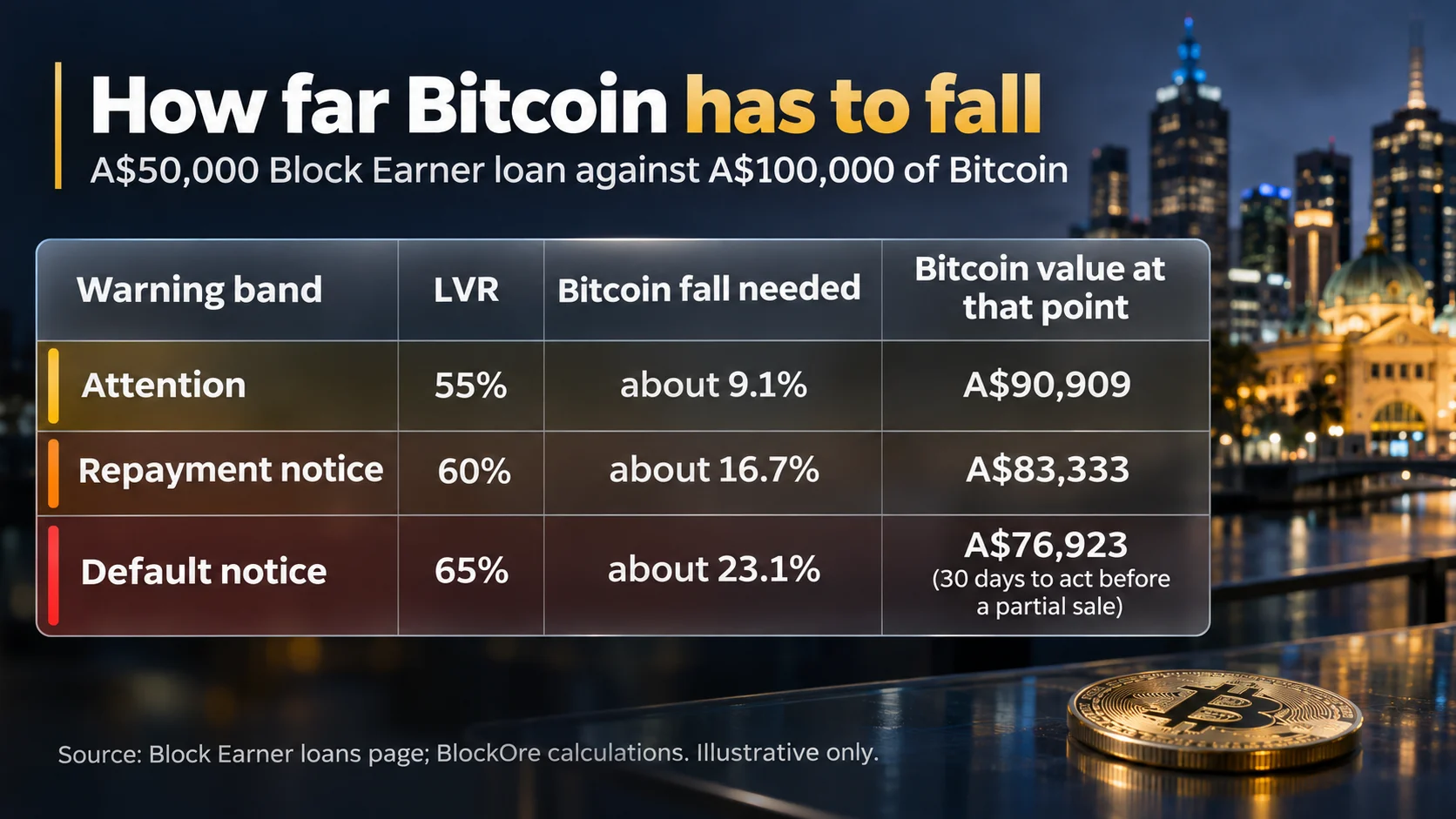
Illustrative maths for a A$50,000 Block Earner Bitcoin loan against A$100,000 of Bitcoin. Bands are from Block Earner’s loans page.
The June court loss was about a different product
Block Earner won its own Australian Credit Licence in May. On 17 June, the High Court ruled 7-0 that its old Earner fixed-yield product, offered from March to November 2022, was a financial product that needed a financial services licence.
Penalties go back to the Full Federal Court. The company has since moved away from yield products.
Cointree’s release doesn’t mention the case, and there’s no reason it should. Loans sit under credit law. Still, a borrower weighing A$50,000 of Bitcoin is entitled to know the lender’s history. A licence governs conduct. It doesn’t cap price risk.
One more mismatch. Cointree’s release says Cointree may sell some security if required action isn’t taken. Block Earner’s FAQ says Block Earner may do the selling. The loan documents are where that gets settled.
Tax adds another layer. A forced sale is generally still a sale for capital gains tax purposes. A borrower who chose not to sell could end up selling by notice anyway, and an accountant can say what that means in each case.
Crypto-backed loans in Australia are turning into a shelf product
Block Earner and Century 21 Home Loans teamed up in September on Bitcoin-backed deposit loans, with a 50 per cent LVR cap. Block Earner said its pilot drew more than A$550 million in waitlist demand.
When one lender turns up in several storefronts, the storefront matters less. The terms matter more.
Three checks are worth making before anyone applies. Where the security sits. Who decides when to sell. And what the loan costs once the 2 per cent fee is counted, since Block Earner charges it again on any redraw.
BlockOre’s recent coverage shows how fast the backdrop can shift. Bitcoin slid towards US$73,600 on 11 November after stronger US inflation data and fund withdrawals, and days earlier an AI stock rout dragged crypto lower. Anyone new to the platforms behind these loans can start with how crypto exchanges work, or browse more crypto coverage.
A loan against Bitcoin works well while the price holds. Five red weeks is a fair test of that.
FAQs
Q: What is the Cointree Block Earner integration?
A: It lets eligible Cointree customers start a Block Earner loan from their account.
Q: Does Cointree lend the money?
A: No. Block Earner provides the credit and makes the decisions.
Q: How much can be borrowed against Bitcoin?
A: Up to 50 per cent of its value, subject to approval.
Q: What happens if Bitcoin falls?
A: The LVR rises, notices follow, and above 65 per cent a 30-day default notice starts.
Q: What does it cost?
A: Block Earner lists 9.50 per cent a year on the line of credit and 11.50 per cent on fixed terms, plus a 2 per cent fee. Rates can change.
Disclaimer:
This article is general information only and is not financial, credit, tax or legal advice. Crypto assets are highly volatile, and a fall in the value of security can force extra repayments or a sale. Rates, fees and terms can change, so check the lender’s current documents before borrowing.

Diana Alexandra is an experienced editor and content strategist with over a decade of expertise across publishing, digital media, and quality assurance. Holding an MA in English and specialised credentials in journalism and editorial practice, she transforms complex ideas and raw drafts into sharp, SEO-driven, and reader-focused copy that meets rigorous publication standards.